Trace the whole journey—from roof to outlet—and ask what happens when the normal route fills or overflows.
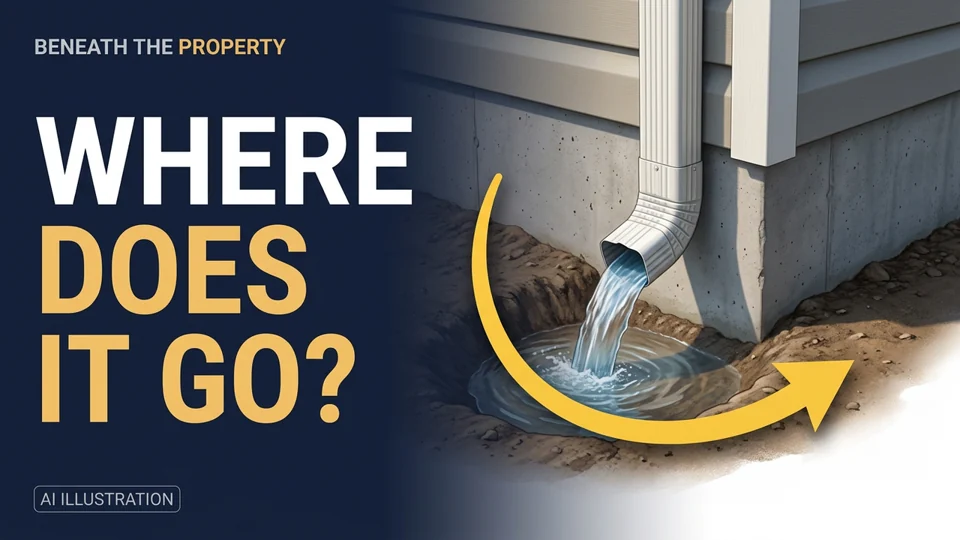
Your gutter may collect rain perfectly and still deliver it to the wrong place. Understanding drainage means following water beyond the downspout: across the ground, through any pipe or channel, and to its final destination.
Before buying a drain or changing landscaping, sketch that journey. Mark the parts you can see and put a question mark beside connections or outlets you cannot verify.
Collection is only the first step
A roof gathers rain over a large area and concentrates it at a few discharge points. Check what happens next. A disconnected elbow, overflowing gutter or blocked inlet may send water along a route the designer never intended.
PNNL’s Building America guidance treats gutters, downspouts and discharge arrangements as parts of a connected system. The presence of new-looking hardware does not establish that the whole route works.
Small landscape changes can matter
A low spot beside a wall can hold runoff. A raised edging strip or a newly laid path can interrupt a surface route. A swale—a shallow channel intended to guide runoff—may look like an inconvenient depression until someone fills it in.
Before altering these features, find out what they do and whether they serve neighboring land as well as your own property. Adding soil beside a building also affects clearances to wall materials and other building details, so avoid treating “add more soil” as a universal remedy.
A pipe needs a suitable destination
Solid pipe carries water along a route. Perforated pipe has openings through which water can enter or leave, depending on surrounding conditions. A subsurface collection system relies on the pipe, surrounding materials and outlet working together.
Ask where the outlet ends, what receives its discharge, and what happens if that receiving area is full or the outlet is blocked. A buried pipe disappearing under a lawn leaves an unanswered question.
Storage also needs overflow
A rain barrel has limited capacity. Once it fills, arriving water still needs somewhere to go. Similarly, a rain garden is a deliberately designed feature; a persistent puddle with plants around it does not demonstrate that the location is suitable for infiltration.
Groundwater, soil conditions, utilities, foundations and slopes affect what is appropriate. A new outlet must not simply shift the problem onto a neighbor or an unstable hillside. Obtain local advice on a suitable, permitted route.
Make a useful drainage record
- From a safe viewpoint, note where runoff enters, flows, gathers and leaves.
- Photograph accessible areas when conditions are safe. Record the date, recent rain and how long ponding remains.
- Mark roof areas, downspouts, inlets, visible channels and known outlets on a simple sketch.
- Record irrigation and known leaks; rainfall is not the only water source.
Stay out of floodwater, flowing channels and unstable ground. Avoid roof access or gutter work during storms. For recurring ponding, water entering the building, unexplained wet areas or substantial changes, seek an assessment appropriate to the site.
Three questions before you buy
Where does roof and yard water discharge? What drainage repairs or flooding have been recorded? Who maintains shared drains and other drainage features? Request available plans and records, then note which answers remain uncertain.
Sources and further reading
- PNNL: Gutters and Downspouts
- PNNL: Swales, Drains, and Site Grading
- EPA: Types of Green Infrastructure
- National Weather Service: Flood Safety
General education, not a property assessment or design. Technical references checked October 5, 2026. AI-assisted writing and illustrations; claims checked against the linked references. How we prepare our guides · Suggest a correction
Keep exploring
Browse the property guides or take the five-question worksheet to your next property conversation.