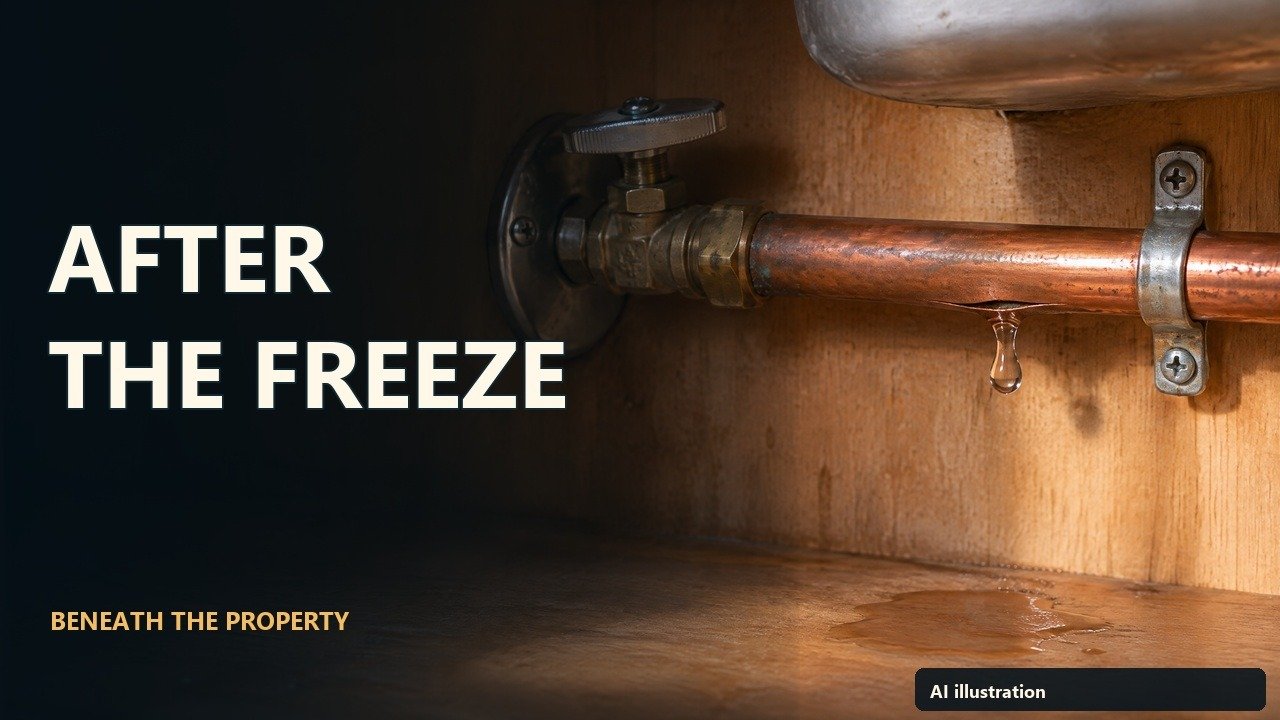
The weather warms up, the ice begins to melt—and a drip appears under the sink. A supply pipe damaged during freezing may reveal its leak as water starts moving again. A thaw is therefore a useful time to check accessible plumbing, rather than assume that the risk has ended.
This guide helps homeowners, buyers and real estate professionals make a practical winter pipe plan: identify the exposed places, confirm the household water shutoff and decide who will respond if something changes.
Why a leak can appear after the freeze
Water expands as it freezes. In a confined section of plumbing, the resulting pressure can damage the pipe. The damage and the visible leak do not always happen at the same moment: water released during thawing may expose a crack that was already there. Some frozen pipes survive, while others leak sooner. This is one possible sequence, not a prediction for every home. Fort Worth Water’s frozen-pipe guidance explains why professional help and caution during thawing matter.
Before cold weather: make a three-part plan
1. Identify the places cold can reach
Begin with outdoor supply plumbing, runs in unheated spaces, and pipes near poorly insulated exterior walls. A thermostat reading in a comfortable living room does not tell you the temperature inside a wall cavity. Use accessible views and existing plans or maintenance records; entering an unsafe attic or crawl space is unnecessary for making a useful list.
Insulation slows heat loss but does not supply heat. The Department of Energy’s building-science guidance describes insulation and air sealing around pipes in exterior walls. A qualified professional can assess the actual arrangement and appropriate improvements.
2. Confirm the household water control
Find out which control serves the domestic water supply. Ask your plumber or utility if you cannot identify it confidently, then label the confirmed control and keep its access route clear. Share its location with anyone responsible for the property. Do not test unfamiliar handles, force a stuck valve or experiment with gas and fire sprinkler controls.
3. Agree on a response
Write down who has access, who checks the heating and who receives a report of moisture or unusual water flow. This is especially useful for a vacant listing or a home whose owner is away. Extended-vacancy winterization needs advice for the whole installation, including connected appliances and any separate irrigation, pool or fire protection systems. Turning one handle is not a complete winterization procedure.
Start with the garden hose
Before freezing weather, disconnect, drain and store outdoor hoses, then follow the winterization instructions for the particular faucet and supply. The American Red Cross includes hose removal among its pipe-protection measures. An outdoor cover alone is not a universal guarantee.
Even a fixture described as frost resistant has operating and installation conditions. For example, Woodford’s Model 17 guidance ties its performance to correct installation and removing the attached hose in freezing conditions. That example illustrates why instructions for one fixture should not be copied onto a different installation.
When water flow slows—or a leak appears
Weak flow is a clue, not a diagnosis. Check your water utility’s notices for an interruption. Utility guidance on low pressure illustrates the range of possible causes; your own provider is the relevant source for current local conditions.
If freezing is suspected, particularly in a hidden or inaccessible pipe, call a plumber. Never use an open flame to thaw plumbing. Keep clear of wet outlets, appliances and electrical panels. If you suspect a burst household pipe, isolate the known domestic supply only when the control and route are safe. If access is unsafe or the control is uncertain, stay clear and seek help. Contact emergency services for an immediate electrical or other emergency.
After the thaw: a useful observation log
Once conditions are safe, revisit accessible cabinet bases, visible supply connections and the outdoor faucet area. Note new moisture or unexpected running-water sounds. The National Weather Service’s after-cold guidance supports checking for problems as conditions improve.
- Where: the room, fixture or visible connection.
- When: when the change was first noticed, including whether temperatures had begun recovering.
- What changed: moisture, flow, a sound or a visible condition—without guessing the cause.
- Who was contacted: the utility, plumber or responsible property contact.
A stain alone cannot establish that a pipe froze. Buyers and agents can use the log alongside questions about previous freezing, repairs and winterization records. A freshly painted surface is not a substitute for that history.
Keep the two water pathways separate
This episode follows water inside supply plumbing. Rain arriving from a roof, street or yard requires a different investigation. Continue with our roof-to-ground rainfall guide to understand that outside pathway.
Editorial note: General education, not a diagnosis or installation-specific procedure. The companion video uses new, labeled fictional AI illustrations and clips, original explanatory animations, and Steven / Eleven v4 AI narration. No pictured property is presented as an actual incident. No paid promotion. For corrections, contact info@beneaththeproperty.com.